WHAT IF? / PART 02 OF 7
When Intelligence Enters the Physical World
Physical AI connects perception and reasoning with action. Robotics, manufacturing and biology may bring the next shift into view.
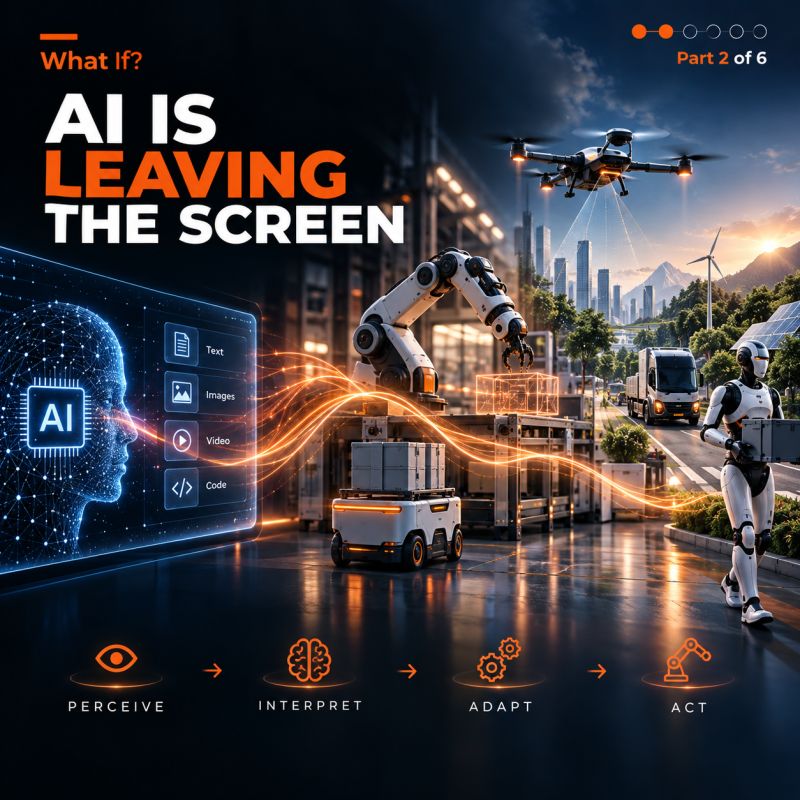
In my last post, I asked:
What if Generative AI is only the beginning?
Then I came across NASSCOM’s recent report on Physical AI, and it added another dimension to that thought.
Most of us currently experience AI through a screen.
We ask. It answers.
It generates text, images, videos and code.
But Physical AI takes intelligence beyond digital applications into machines and systems that can perceive, interpret, adapt and act in the real world.
Think robots, autonomous vehicles, drones, factories and intelligent infrastructure.
And this is where things start getting really interesting for me.
Because once AI can understand the physical world AND act within it, the next question is no longer just:
"What can AI generate?”
It becomes:
“What can AI build?”
Now add robotics.
Add 3D printing.
Add advanced materials.
And eventually add synthetic biology and gene editing.
The boundaries between software, engineering, manufacturing and biology start becoming less clear.
NASSCOM sees Physical AI creating new opportunities across the engineering lifecycle, with increasing importance for integrated AI, engineering and domain capabilities.
Maybe the transition we are witnessing is:
Generative AI → Physical AI → Generative Science.
AI started by creating things we could see on a screen.
Now it is beginning to interact with the world outside it.
And I think that's where this story becomes much bigger.
Next thought: What happens when AI, robotics, 3D printing, CRISPR and synthetic biology start working together?
#WhatIf #PhysicalAI #GenerativeAI #Robotics #FutureOfTechnology #Innovation #NASSCOM
https://lnkd.in/gN4Gu2j8