WHAT IF? / PART 05 OF 7
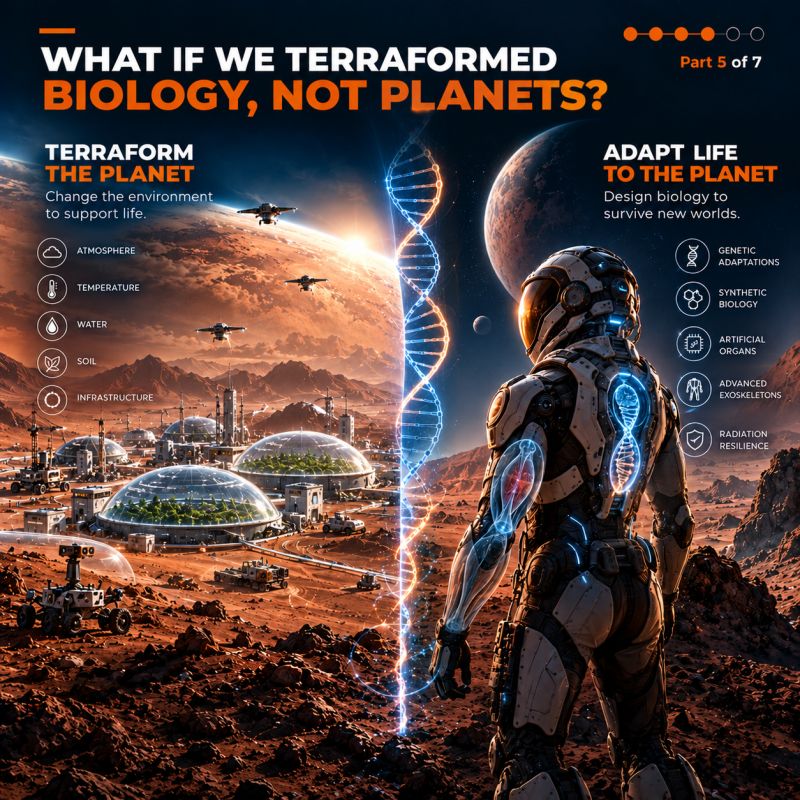
Why terraform a planet when we could terraform biology?
A speculative reversal of planetary engineering: could biological adaptation and technology help life inhabit unfamiliar worlds?
What If? | Part 5 of 7
Why terraform a planet when we could terraform biology?
Elon Musk envisions making Mars habitable for humans.
But what if we reversed the approach?
Instead of changing an entire planet to suit life, what if we designed life to suit the planet?
AI is already helping design proteins and discover medicines. CRISPR allows us to edit genes, while synthetic biology is opening new possibilities.
Now imagine these technologies converging with robotics, artificial organs and intelligent exoskeletons.
Could we someday create life forms adapted to extreme temperatures, radiation and unfamiliar environments?
Of course, biology cannot overcome the laws of physics. But perhaps the future lies in combining biological adaptation with technology.
Maybe we don't need to make every planet Earth-like. Maybe we need to rethink what life can become.
And here's an even bigger thought:
What if humans don't need to make the journey at all?
More on that in Part 6.
#WhatIf #GenerativeAI #SyntheticBiology #CRISPR #SpaceExploration #FutureOfTechnology #Elonmusk